How to track a weekly injection like semaglutide

Written by the PeptideMate Editorial Team Updated · 3 minute read · 2 sources
For a once-weekly injection, log four things on dose day (date and time, amount, injection site and the pen or vial used), set a repeating weekly reminder, and record your weight and any side effects on a fixed day each week. A week is long enough to forget both whether you took the dose and which side you used, which is exactly what the log is for.
GLP-1 medicines such as semaglutide and tirzepatide are prescription treatments. Your dose and schedule are set by your prescriber. This guide is about keeping the record.
What should you log on dose day?
| Log | Example |
|---|---|
| Date and time | Sunday, 9:00 am |
| Name and amount | As prescribed |
| Injection site | Abdomen, left |
| Pen, vial or lot | From the label |
| Notes | Anything out of the ordinary |
Set one repeating reminder
Pick the day and time you were given and set a weekly reminder for it. If your prescriber changes the day, change the reminder the same day so the two never disagree.
If you miss a dose, follow the instructions in the patient leaflet or ask your pharmacist. Log what you actually did.
If your medicine comes in a vial rather than a pen, check the concentration on the label every time it changes. The US Food and Drug Administration has reported overdoses of 5 to 10 times the intended amount after milligrams, millilitres and units were confused with compounded semaglutide. How to log a compounded GLP-1 vial lists what to copy from the label, the tirzepatide and semaglutide calculators show the arithmetic, and mcg, mg, mL, units and IU explains the difference between them. Store pens and vials as the label says; peptide storage uses the Ozempic label as a worked example.
Alternate sides and write it down
With seven days between injections, "which side was it last time?" is a real question. Recording the site with each dose answers it. See how to keep a site rotation log, and subcutaneous injection sites and rotation for where the usual sites are.
What should you track between doses?
Short, regular notes are more useful than long, occasional ones. If you are just starting, what to track in your first month on a GLP-1 sets out a baseline and four weekly entries.
- Weight: same day each week, same time of day.
- Waist or other measurements: every two to four weeks.
- Side effects: on the day they happen, with a word on severity. How to keep a GLP-1 side effect diary has a format.
- Appetite, energy, sleep, mood: a quick check-in a few times a week.
Before each appointment
Dose changes are your prescriber's decision, and a clear record helps them make it. Bring:
- The dates of every dose since the last visit
- Any missed or late doses
- Side effects and when they happened
- Your weight trend
The full checklist is in what to share with your doctor.
Doing this in PeptideMate
- Type the medicine name once; it becomes a one-tap chip on the dose entry screen.
- Create a weekly schedule with a reminder.
- Tap the body map to record the site.
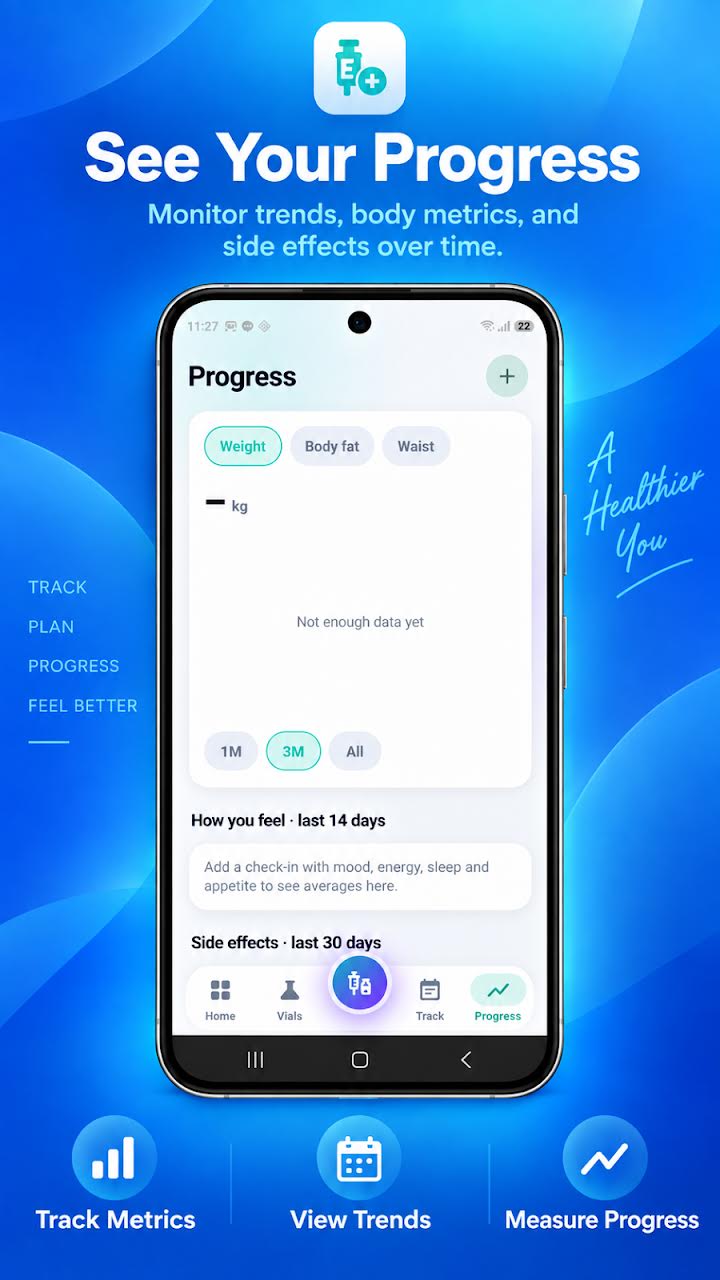
- Add weight, body fat and waist in Progress, with check-ins for mood, energy, sleep and appetite.
- Export the history before your appointment.
Common questions
Can a peptide tracker be used for GLP-1 injections?
Yes. PeptideMate logs any named compound, so it works for a once-weekly prescription the same way it does for anything else. What to look for in any tracker is in how to choose a peptide tracker app.
Does the app tell me when to increase my dose?
No. PeptideMate does not recommend doses or schedules. It records the ones you enter.
Sources
- Ozempic (semaglutide) injection: prescribing information, section 16, Novo Nordisk, via DailyMed (US National Library of Medicine).
- FDA alerts health care providers, compounders and patients of dosing errors associated with compounded injectable semaglutide products, US Food and Drug Administration, July 2024.
This guide is about record keeping and unit arithmetic. It is not medical advice. See the medical disclaimer.